Critic-at-Large

Record Roundup
Honey Dijon: The Nightlife
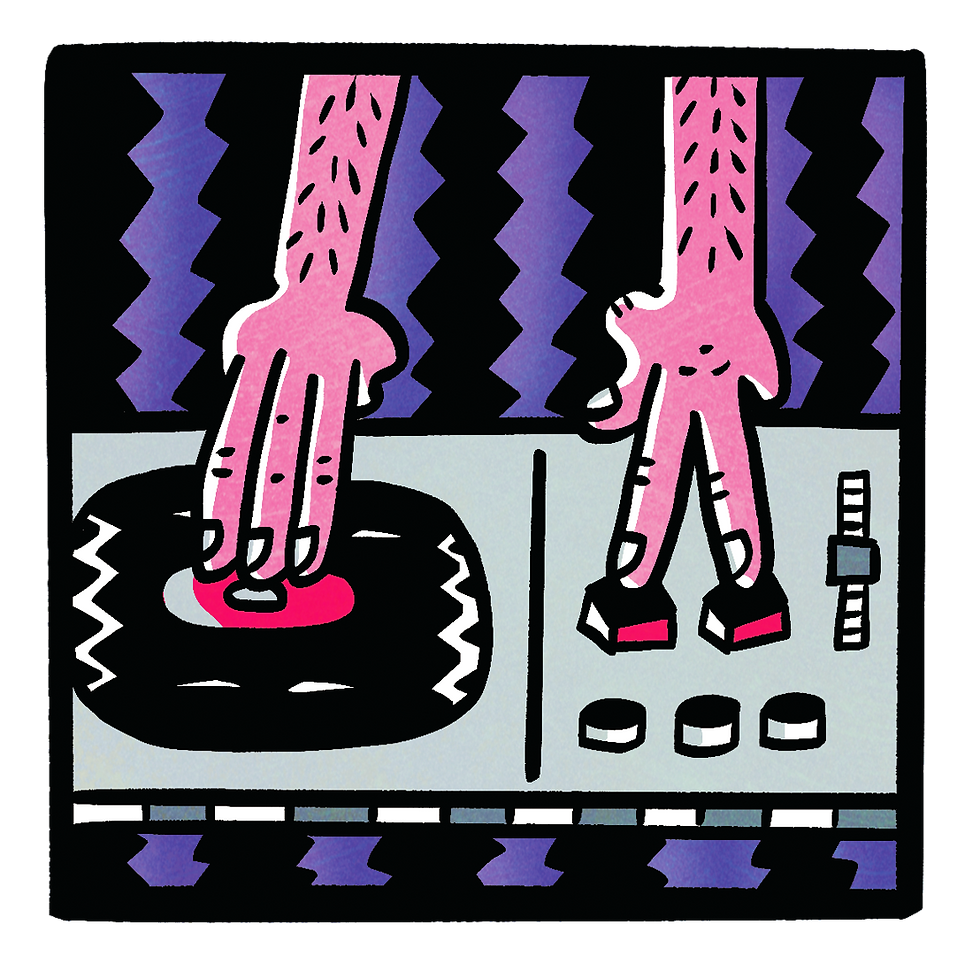
Honey Dijon is an extraordinary and extraordinarily respected DJ known for her Chicago-style deep house music; largely the domain of black queer innovators in the early 80s, Dijon continues in the tradition of the likes of Frankie Knuckles and Marshall Jefferson. Her gifts are best exemplified in her tour-de-force Boiler Room set at Sugar Mountain in 2018, a set which has something of a cult following in itself. In a recent interview, Dijon revealed that she was flustered, running late thanks to a promoter mismanaging a car booking, and really needed to pee during that set—she wasn’t particularly proud of some of the mixing as a result. And yet, what unfolds is absorbingly authoritative, as Dijon takes the unexpecting daytime Aussie crowd on a romp through house music history, including even a sample of MLK’s “I Have a Dream” speech, just in case you ket-addled rave kids forgot where these beats came from. Her gifts, albeit that of a different kind, are also exemplified on her new record, The Nightlife. Here, it’s Dijon-as-producer, coordinating a number of collaborators and session musicians. “Just Friends” cools things off; “Satisfied” demands better, as much for an interpersonal relationship as for black pride in general; “Welcome to the Moon” images the dancefloor as extraterrestrial, a place where you move different than everywhere and everyone else (read: the straight world); “Okay Daddy” goes silly and bratty (and doesn’t its bassline have something of Mr Fingers’ classic track “Mystery of Love” about it?)—but the “story” this album tells is not one of linear narrative cohesion, it’s one of sheer formal efficiency. With most clocking in under four minutes, these tight and well-managed tracks don’t hypnotise in their length and sustain, as Dijon does in her DJ sets. Rather, they’re poised to arm DJs of her ilk with fresh and lively new material out of which to cut mixes of their own. We can only hope, Wellington, that people take up her challenge. I, for one, largely raised on this sound, am a little sick of the high-tempo techno reign in this city. Let’s party Chicago style, baby. Or, as guest vocalist Mahalia has it on one seriously flirty track: “Don’t rush me / Take your time, we’re not in love” (“Rush Me”).
Jessie Ware: Superbloom
Aw, Jessie Ware! Gardens and sexuality have been weirdly linked for as long as, like, the Book of Genesis, I guess? Or at least since it’s Troye Sivan’s 2018 bottoming anthem “Bloom.” Ware’s engagement with this trope on Superbloom is to turn it into pure bodily agitation, a command or excuse to dance. For me, “Sauna” is the zany highlight, highly sexed and furnished with a nonsense hook: “If you wanna last longer / I don’t need faster, I need stronger / Take it to the sauna.” You get the sense that she led herself there with the rhyme, which has its own logic or way of making things seem logical; and there’s that really lovely synth work, trembling and semiquavering all over the track, grounded by a digital piano whose chord progression endlessly encircles completion. By comparison, I find and have always found Ware’s ballads pretty weak in their posture—and here, “16 Summers” is no exception. But “Ride”, the lead single... it’s just signature Ware. It’s campy, vampy, disco-y, and—what’s that?—it’s got an Ennio Morricone sample. Of course it does. And who’s that on the keyboards? Stuart Price. Of course it is. Bravo tutti.
Noah Kahan: The Great Divide
Before dance music dishevelled my beautiful mind, I was a connoisseur of that particular kind of folksy singer-songwriter who came after Leonard Cohen and Joni Mitchell: poetic, subtle, intelligent, led by the voice and persona of the singer. And I do have a real soft spot for Noah Kahan, who came to prominence a few years ago with 2022’s Stick Season. Kahan’s latest, The Great Divide, is in the same style and thematically encircles the same concerns, which would be concerning for an artist working in any other genre. But, like the poets, the singer-songwriters have discovered the basic truth that some things, like “I love you,” are worth repeating. For Kahan, that’s true, but it’s also true that some things merely repeat, as in the demeaning cycles of paycheck-to-paycheck labour—and he’s a faithful scribe of that kind of suffering capital wants to make invisible. “American Cars” almost evokes for me the Springsteen of “Racing in the Street” whose narrator’s got nothing but the race—but Kahan’s song is bogged down by 21st-century malaise, its depressed narrator “gaslighting [his] friends” and sick of false promises of escape (“You’ve been driving all day / But you’re home and I’m so grateful you are”). Meanwhile, continuing our automobile theme, “Headed North” channels road rage against a Tesla Cybertruck. Fuck yeah! “But at least I got a soul still”, Kahan sings on the bittersweet “Haircut,” a song which tries hard to balance resentment with sympathy for an old friend. Kahan was there for them when they were down—but now they’ve left their hometown and write for the New York Times! Resentment seems to be winning out, which is always the threat in Kahan’s world of small-town couch-surfing left-behinds. But when he hits the applied chord ([V/iii] for those of you following along at home) on the chorus’ phrases “fast food” and “bad news”—driving harmonically onwards at the moments in the lyric when defeat seems most available—some stodgy part of me delights in an old cliche so simply and coherently indulged. You could almost call it idiomatic.
Jonathan Biss, Swedish Radio Symphony Orchestra: Beethoven/5, Vol. 5
Well, well, well. Before the po-faced singer-songwriters bludgeoned me into acceptance of mediocrity, I was a classically-trained flautist. True story! Beethoven/5 is the brainchild of the American pianist Jonathan Biss, known for his interest in the composer, and Volume 5 completes the project, which was to commission and record live five new piano concertos, each responding to one of Beethoven’s. I’ll confess I’m largely here for Caroline Shaw, one of my favourite living composers, whose commissioned response, Watermark, is very cool. In Watermark, she’s unafraid to quote quite extensively from Beethoven, and ornaments his figures with orchestration techniques and prog-ish harmonies that will hopefully feel familiar to fans of Johann Johannssohn and Radiohead alike. The second movement in particular is quite stunning: Shaw’s taste for pizzicato textures and stutteringly swelling string figures is on display, as well as her strong command of voice leading. In the album’s main dish, Beethoven’s third concerto, the Swedish Radio Symphony plays well under their concertmaster Malin Broman, though the winds are a touch “vertical” in their phrasing—not bad, necessarily, for Beethoven, I suppose, but neglecting the fury, the rushes of thought and expression, that are a hallmark of the composer’s style. While Biss takes quite a refreshing, literal approach, I do wonder if he or his audio engineer could have coaxed out a little more variety in the colour of his playing, especially in the third movement. Nonetheless, it’s hard to be disappointed at the completion and release of this lovely project, which reminds us that Beethoven at his best is not to be treated as a monument but a friend, someone whom we are still in dialogue with centuries after his death.