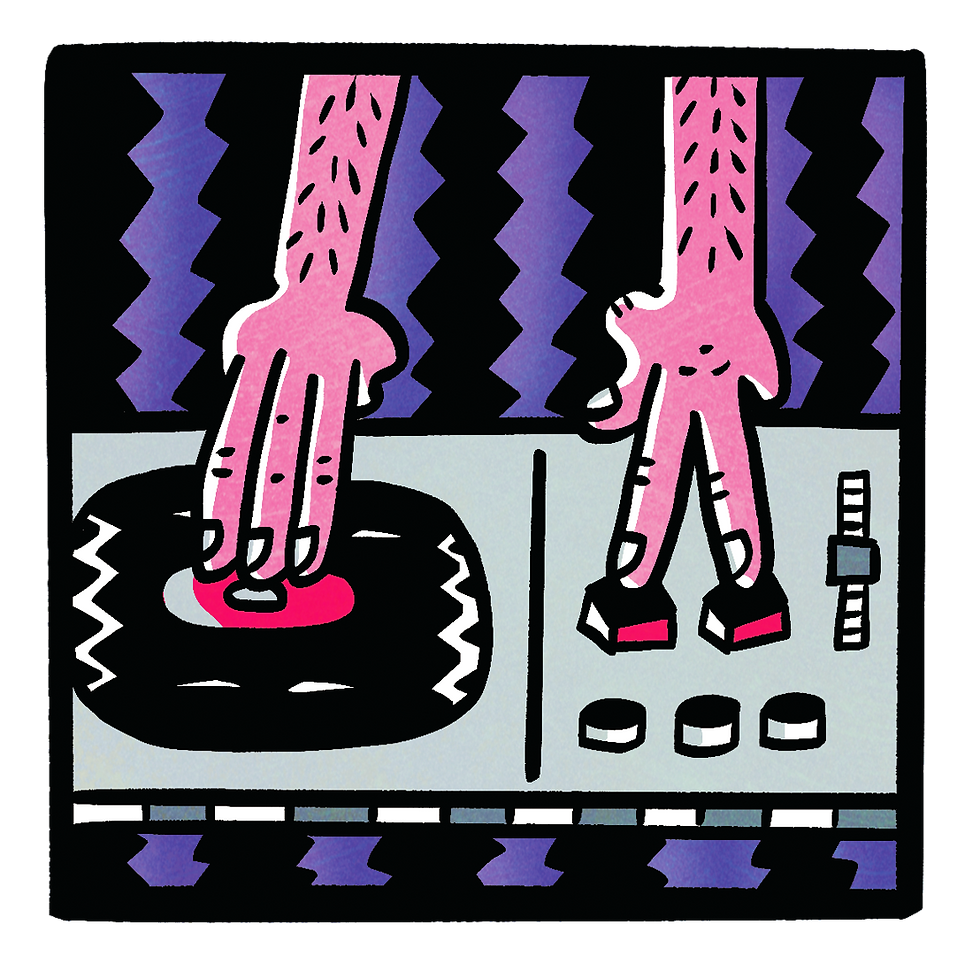
What do baby snatching, brainwashing, and violent girlbossing all have in common?

Pedro Hay
If you’ve ever found yourself at a party, completely lost for something clever and interesting to say, perhaps you’ve tried sneaking in your incredible insect knowledge by mentioning that most ant species can lift ten times their own bodyweight with ease. Not only would this make you look really weird, but it’s also a lame fact. You should probably excuse yourself from the conversation at this point.
If you want to really be the life of the party, tell them about the ants that have instead mastered the ability of sitting on their lazy asses and making other ants do the heavy lifting for them.
One big thing that studying both biology and international relations has taught me is that, as horrific as nature can be, humans manage to achieve far worse every single time. Despite this, the animal kingdom does manage to rival some things we consider to be uniquely and terrifyingly human. Ants, for example, have been practising slavery for a lot longer—and far more effectively—than humans have.
‘Slaver ants’—as I’ll refer to them in this article—comprise roughly 50 to 60 species found around the world, mostly across the USA, with others found in Mexico and parts of Asia.
The genus Polyergus contains 14 species split into three groups: the Rufescens, Lucidius and Samurai groups. The last of which sounds incredibly badass, although it is limited to only two known species, so there’s not much for me to write about.
To preface: I don’t know how fair it is to call these ants ‘evil.’ While they are incredibly smart, they are still just ants. As you’ll see, the way this slavery occurs is very different from anything in the human world. However, I think it’s funny to vilify insects, and they’re unable to write a formal letter calling me out for my bullshit, so I win.
But enough ant ethics. Enough taxonomic classifications. Let me tell you how these little fuckers get down.
Polyergus are ‘obligate parasites,’ meaning they cannot survive without a host species to exploit. These ants have spent so long evolving into the perfect slavers that they have essentially lost the ability to properly care for themselves. Many of your flatmates may also be this way, just with much more Uber Eats involved and, hopefully, without the slavery part.
Slaver ants are reliant on enslaved workers to feed them, clean them, raise their young, build and expand their nest, and carry out just about every other task. The only thing they do know how to do is to raid other nests and capture workers.
Fortunately for them, and unfortunately for everyone else, they are very good at it.
Raids occur much like approaching a VUWSA free-food table in the Hub, with a three-step-process: Locate, Attack, Snatch.
Scouts venture out in search of nearby colonies. Polyergus almost exclusively target ants belonging to the genus Formica, which has less to do with ant racism than with the fact that finding a Formica nest is about as difficult as finding someone wearing Dr Martens in Wellington.
Once a scout finds a nest, it returns home and releases pheromones to excite its fellow ethics-ignorers and round them up for a raid.
The resulting army arrives at the target nest and rushes in, ignoring the defenders as much as possible and making a beeline—antline?—towards one part of the colony in particular.
They aren’t looking for a fight. They’re looking for babies to kidnap.
It’s much easier to drag home defenceless larvae or pupae than a fully grown ant kicking and screaming. The defending ants, however, are no pushovers. Some Formica species have powerful cutting mandibles; some can spray acid from their butts; some can probably freestyle a mean diss track on the spot and destroy a slave-raider’s ego in seconds.
The slavers have little reason to fight an actual battle. In fact, it is in their interests for as many defenders as possible to survive: those ants can keep the colony alive, allowing the slavers to raid it again later.
To solve the tricky problem of avoiding a real fight when your sole objective is kidnapping babies, the slavers have developed a neat little trick.
Chemical warfare.
During a raid, they release pheromones that incite panic and confusion among the defending ants, disrupting any organised defence. The next time you have three essays all due on the same date and wish you could reincarnate into some kind of small bug that doesn't have to deal with that shit, be grateful that you’re not an ant having an army of child-snatchers break into your house, cart off your children, and spray everyone with fear chemicals like a tiny knock-off of the Scarecrow from Batman.
After a jolly ol’ session of kidnapping and biochemical terror, the slaver ants deposit the captured young into their own nurseries—minus the few that are eaten as a post-raid snack.
Then come MORE pheromones.
As the captured larvae and pupae mature, they become chemically integrated into the slaver colony and come to recognise it as their own. Because apparently these ants love nothing more than spraying propaganda juice everywhere whenever they run into a problem.
Once fully grown, the enslaved ants get to work acquiring food, feeding their hosts, raising slaver larvae, expanding the nest and keeping the place clean.
Despite this apparently well-engineered system for producing obedience, loyalty is not always guaranteed.
Researchers have observed enslaved ants killing slaver pupae after apparently learning to distinguish them from enslaved young of their own species. This does not directly improve the workers’ own chances of escape or survival. One explanation is that killing the slavers’ young indirectly benefits nearby colonies of their own species by reducing the number of future raiders.
How dark and beautiful is that?
Never let anybody tell you that bugs are boring ever again.
If the uprisings weren't action-packed enough, the James Bond-esque missions undertaken by young slaver queens to establish new colonies should give you enough adrenaline to tackle that assignment you’ve been putting off.
As you now know, slaver ants are useless at establishing and maintaining nests without workers. So what is a young queen—both literally and in a girlboss-like-my-girlfriend kinda way—supposed to do when it is time to leave home and start a colony of her own?
She ventures into the wild in search of a new Formica colony.
She can’t pick one too close to her original nest, because she risks being killed by her own soldiers as competition when they later come looking for new slaves. Even ants fall victim to tall poppy syndrome.
Once she finds a suitable nest, the badassery begins.
The queen charges into the nest and makes her way toward the colony’s queen, deep within the nest. She uses those same disruptive pheromones to bamboozle the defending soldiers, but only has a short window before she risks being torn apart.
Once she finds the queen, the coolest part begins.
Some of my flatmates have started binging Game of Thrones recently, and now all I hear about is royal smackdowns and how gory everything is. Clearly, they have not watched the far more entertaining series Hours Upon Hours of Ant Videos on Youtube Watched at 2am.
As she bites into her rival, she repeatedly licks her opponent’s wounds, covering herself in her victims pheromones.
And because apparently this wasn’t difficult enough, Formica colonies can have multiple queens, meaning the conqueror may need to repeat the process several times to complete her takeover.
This ruthless succession—effectively the ant version of somebody killing the prime minister and then jumping into their skin as a disguise—is simply how these creepy-ass ants establish new colonies.
The victorious queen begins laying eggs. Meanwhile, the original workers continue serving the colony until they die, unaware of what happened to their original rulers—who are also their mothers, because yeah, it wasn’t dark enough yet.
Hooray!
To all of you freaks who have read this far: congratulations. You have made it through the dystopian ant hellscape, but unfortunately not the dystopian human hellscape.
Everyone from Wellington can agree that clothing and fashion are a big part of this city's culture. Take a minute to look down at your meticulously crafted fit—or just whatever clean T-shirt and sweatpants you could find in five seconds of bleary, half-asleep rummaging—and ask yourself: how was this made?
And not just your clothes. Think about your phone, food, jewellery and the countless other mass-produced things you use every day. Somewhere along their supply chains, many products can be linked to exploitative labour practices, including modern slavery.
When you hear the word ‘slavery,’ your mind may first go to something historical: perhaps ancient societies or the transatlantic slave trade. But tens of millions of people are estimated to be living in modern slavery today. The institution has changed shape, but it has hardly disappeared.
So what’s the move from here?
Firstly, you can throw yourself into a depressive slump for a couple of minutes, which is fair.
Afterwards, start thinking realistically about where you can reduce your reliance on goods connected to exploitative supply chains. I’m not about to tell you to simply stop buying clothes and food, because if that’s all I offered at the end of this article I’m pretty sure the editor would drag me out back and shoot me.
Challenge yourself to cut down on buying new clothes. Buy second-hand where you can—oh really? Thrifting in Wellington?—and yes, I mean actual second-hand, rather than vintage stores that keep feeding the constant churn of clothing while pretending to be progressive and rebellious.
At the supermarket, look for Fairtrade certification where it’s available, and consider weekend veggie markets or buying locally when you can. I understand these options can cost more than is practical for a broke uni student, but even paying attention to where things come from is a start.
End Slavery Now is also worth checking out for information about modern slavery and ways to take action.
This is also where the ant comparison reaches its limit. Polyergus ants are not moral actors. They do not choose a political or economic system, understand exploitation, or decide that the convenience of cheap labour outweighs someone else’s freedom. They evolved into a way of life they cannot step outside.
Humans do not have that excuse.
Modern slavery survives through choices made by governments, companies and consumers, but those choices are not equally powerful. A student deciding whether to buy a $12 T-shirt does not control a global supply chain in the same way as the company that designed it, the supplier that manufactured it or the state that regulates the market. Individual choices matter, but they are not a substitute for laws, enforcement and corporate accountability.
Maybe that is the useful thing ants can teach us after all. Not that humans are uniquely evil, or that exploitation is somehow ‘natural’, but that dependence can become embedded in a system until it looks ordinary to everyone inside it.
Ants cannot question the system they inherited.
We can.