Salient Weekly Challenge: Planes, Trains, & Rollators
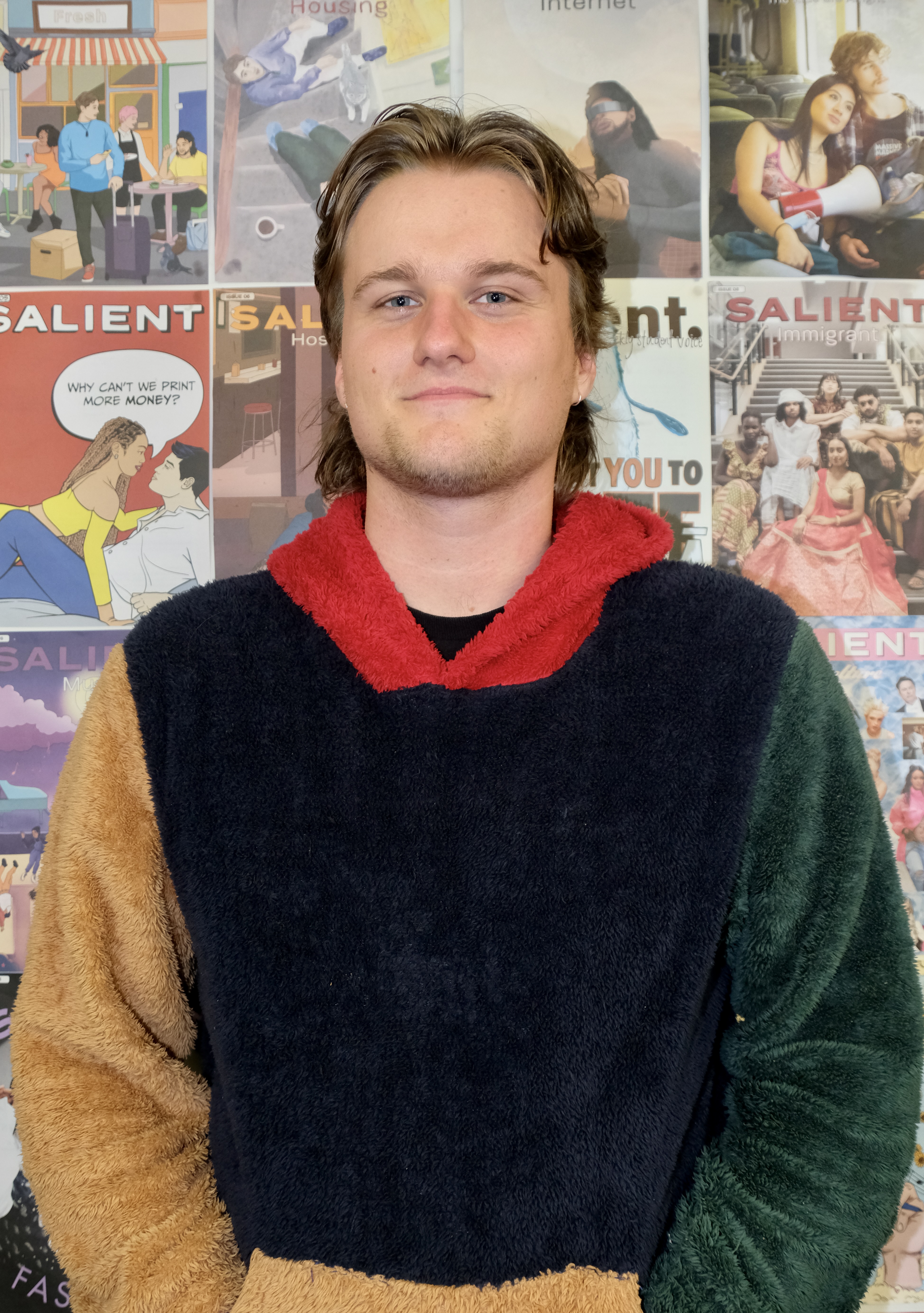
By Will Tickner, Tam Maxwell, and Teg Ward
Within the span of a week, I’ll be trying to accomplish a long-term task just to see if it’s possible, and to see what I can get out of it. Life lessons, skills, resilience training? The stimulation alone should be enough motivation.
During an event last year, I had to move a big load of tables and chairs from Fairlie Terrace to the Memorial Theatre. What I thought was a ten-minute trip turned into a half-hour sweat-fest of cussing as I located ramps and working elevators. It took the removal of stair-use to realize how shit some accessibility on campus is.
What exactly are the differences between able-bodied and disabled students getting around campus? I wanted to create this weekly challenge around that idea. As an able-bodied person, I couldn’t do this alone. Thankfully, I was graced with two people from the Classics department: Tam, a rollator user, and their friend Teg, a part-time cane user. To start the challenge off, I asked if Tam could come into the Salient office to discuss their thoughts on campus accessibility. An ironic event took place:
Tam: Hey, Will?
Will: yea
Tam: I can’t use the stairs in the student union building.
Will: huh
Tam: Because I use a rollator.
Will: what
Tam: What’s the accessible way to get to the office?
Will: um
Turns out the accessible way we found is to take the elevator through the Student Union building to the third floor, go into the Hunter Lounge, go to the back of the bar, and use the back door. If there’s ever been any previous Salient employees who have had to deal with that nonsense, please let me know, because that cannot be the first time this has happened. After that ordeal, Tam and I came up with a simple obstacle course of locations that students can imagine themselves getting to: Cotton Plaza to Mauri Ora Student Health, then to the Von Zedlitz building, and back again… all at a regular pace.
Round 1: Cotton Plaza to Mauri Ora
The three of us met at Cotton Plaza and soon started our timers as we began our routes to Mauri Ora. Teg and I took similar paths, both descending the big flight of stairs down to the Student Union dungeon. However, Teg took the elevator upon reaching the Bubble. Teg has a lot more mobility than other disabled students, as for some cane users going down stairs is a lot easier than going up. But depending on how they're feeling, their mobility can change. Another ironic fact is that in their undergrad, Teg actually spent a day mapping the best routes between all their classes and timing how long it took. This information was needed so they were able to get from place to place in time, as sometimes the route they needed to take wasn’t necessarily the ‘normal’ route. It should be noted that while he does suffer from a bad knee, Teg has multiple other conditions that don’t interact with their cane, as disabilities aren’t always visible—asthma, endometriosis, and problems with body temperature regulation all limit their mobility in subtle ways, namely going uphill for any extended period of time.
“I could walk up the stairs, often even without my cane… but I choose not to, because even though it may be physically possible, I’ll be miserable doing it, and I’ll be miserable for at least 15-20 minutes afterwards.”
Therefore, Teg personally chose routes that had the least amount of stairs going up and physical strain. Tam, on the other hand, doesn't have the option of stairs. They had to take two elevators (the one in Mclaurin, and the Student Union) to reach their destination, coming in at just over six minutes. That’s almost twice as long as it took me.
Round 2: Mauri Ora to Von Zedlitz
Getting to the Von Zedlitz building already takes weird navigation, regardless of whether you’re not able-bodied. As we were starting the second leg, Tam informed me that I could get there quickly—all I had to do was go outside. I got there in a little over two minutes, as I simply walked into the parking lot and cut through to the Hunter Courtyard to cross the road. As the street entrance to Hugh MacKenzie has ZERO ramps and ONLY stairs, Tam & Teg both had to take much longer routes. Teg had to wait for two elevators, while Tam waited for three. Tam technically finished their trip before Teg, as they entered Von Zedlitz at the third floor from the Murphy Building. However, because we agreed to meet on the first floor, Tam had to take the notoriously rickety Von Zedlitz elevator to meet us at the bottom.
Tam has longstanding beef with campus accessibility, and after hearing their qualms I wholeheartedly agree. They’ve badgered concerns about the inaccessible nature of campus many times to countless individuals, none of which have been taken seriously. In one instance advocating for disabled students, Tam attended a scholarship reception event where they approached the then-Vice Chancellor (good ol’ Nic Smith). They asked if he was aware of how inaccessible the university is. When he said he wasn’t, he only had the chance to listen to some of the examples Tam gave before staff pulled Nic away on other business. Even though that staff member took Tam’s contact details and was told further discussion on this issue would be organized with the VC, it never eventuated.
As they are a member of staff as a tutor, Tam received email updates on the selection process for the new Vice Chancellor proceeding Nic. In some of the correspondence, they mentioned that select focus groups would be composed to provide feedback on the candidates and ensure that all the voices of the university, both staff and student, were heard during the selection process. Tam actually emailed and asked if they would consider adding some disabled voices to one of the focus groups, as a reason to ensure that the uni gets a VC who cares about disabled students and staff. The email response?
Tam: “While they mentioned "exploring candidates thoughts and past experiences" on the topic in the interviews, they didn't mention anything about how this might actually go, or indicate that they have any active plans to include [disabled] voices in the consideration process, simply that it would be a great opportunity. Overall, disappointing in my view.”
Round 3: Von Zedlitz to Cotton Plaza
This was the most eventful leg of our challenge. I ended up not having a great idea of how to get to Cotton Plaza quickest, and took a few wrong turns in the stairwell of the Murphy building which added a chunk of time. Despite this, I was still fastest again by a full minute, as Teg came in second. Tam finished well after Teg and I, passing the finish line of Cotton Plaza to find the two of us waiting for them on our phones.
Why did Tam take so long? Well, to get to their destination, Tam took one of the "accessible" lifts in the Hub. Apparently, they’re the small elevators on the bottom floor of the Hub that take excruciatingly long to raise about two metres off the ground. They’re loud, embarrassing, and you could probably walk up and down the set of seven steps next to it over twenty times. Tam may as well just have thrown themselves down the stairs and take the time to physically recover, and still make better time. It’s little instances like this where small sets of stairs set Tam back to get somewhere, as there is no clearly marked accessible route to follow.
Conclusion:
Being able-bodied is a much bigger privilege than you realize, as we proved that it takes a disabled student marginally longer (sometimes twice as long!) to reach a destination. However, there’s elements we could’ve changed. We didn’t conduct the test during the 10-minute gap between lectures, as if we did there would be more people to get in our way. I had also caught Tam & Teg on a fairly good day for mobility, and we could have made the trips larger to show stronger differences.
While there’s a lot that could have been done differently for our challenge, the same can be said for campus accessibility. Tam & Teg both brought up points to make campus more accessible in easy ways, such as adding more automatic doors, more intuitive routes, or god-forbid a ramp at the street entrance to Hugh Mackenzie. But the big thing that was brought up was making recordings of lectures and online tutorials mandatory. Despite multiple Covid lockdowns forcing institutions to go online for accessible forms of teaching, they are no longer a requirement. As a primarily Zoom-focused tutor, Tam can vouch for them being a worthwhile tool students engage with when they can’t make it to class.
Accessibility on campus isn’t a problem until it happens to you. If your bus route into the city gets cancelled, or you’re bed-ridden due to a flare-up, wouldn’t you need those lecture recordings? Better yet, what happens if you have an accident that leaves you affected? Teg says it best:
“Anyone can become disabled at any time, and a lot of people just don’t realise that. My bad knee happened because I fell down some stairs in 2015, and now I’m here, and everything that can be done about it has been done, and it will never be the same again. Put the accessibility measures in place now, even if you personally do not need them, because one tiny accident that you paid no attention to at the time might have you needing them.”