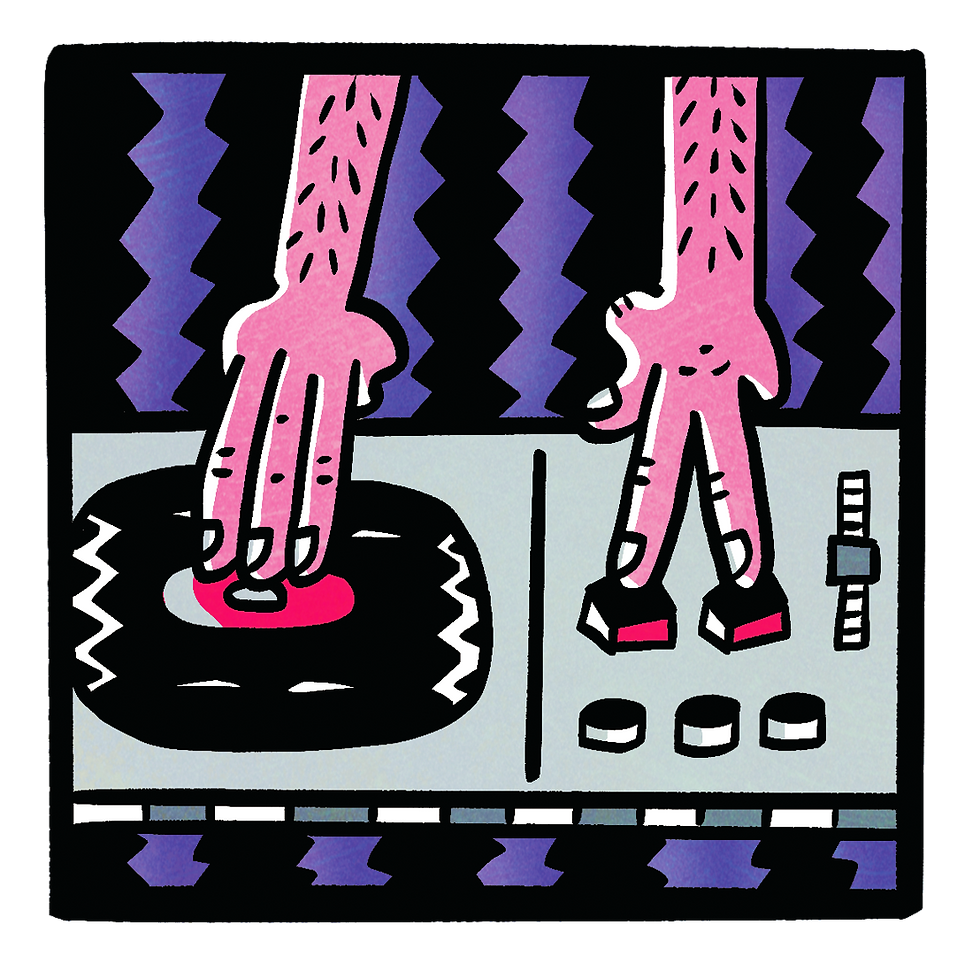
Opinion: Death by a Thousand Canvas Notifications

For neurodivergent students, Vic’s first-week madness is not just admin, but a barrier for learning.
Molly Laurence
Courses are hard enough. But the first few weeks back at university are even worse. New classes, new classrooms, resource layouts, tutorial sign-ups, platforms, schedules, announcements. For most people, I imagine it’s overwhelming.
For neurodivergent students, it can be something else entirely.
As a second-year law student with dyscalculia and ADHD, for me, the start of the term feels less like orientation and more like I’m being told to fuck off.
Dyscalculia is like dyslexia, but with maths. Where dyslexic people generally face additional challenges with reading and writing, dyscalculic people struggle with numbers, maths, and mathematical thinking. Combined with ADHD, it means that the internal secretary most people seem to have—the one that books appointments, remembers times and places, and handles small logistical tasks—simply doesn’t exist in my head.
In their place is a small child motivated by bright colours and pretty dresses.
As a result of much work, the university has made real progress in accommodating students with disabilities, and I respect that effort. But when it comes to invisible neurological differences, especially in the administrative chaos of the first weeks of term, the system feels profoundly hostile.
Sorting my timetable for one class at the start of the trimester took me two cups of tea, an hour (I think), tears, and two phone calls.
And that’s not unusual.
It’s a nightmarish onion nesting doll of confusion: each layer giving way to stinging tears and a new level of administrative horror.
A quiz I can initially only find on my phone asks me ten questions on a seminar I didn’t realize I missed.
I find out I’ve missed two seminars that MyAllocator didn’t say were happening.
Strangely enough, when no seems to know what what dyscalculia is—even the student magazine simplistically previously categorized ADHD as “including inattentiveness, hyperactivity, and impulsivity” (shout-out for talking about it, but for the record: I have none of those)—it feels isolating.
To be dyscalculic, and neurodivergent more broadly, is to exist in a world set to a default that isn’t yours. It can feel like death by a thousand Canvas notifications—a constant series of small collisions with systems designed for someone else’s brain. A thousand little moments of: Oh wait—this is a thing as well??
See: me spending what I can only assume was an hour (hello, time-blindness) ploughing through a plate of roast potatoes because estimating portion sizes is apparently a skill people have.
See: my default speed being a fast-walk, because I’m usually running late—and yet somehow still arriving at my class an hour early… again.
See: me fiddling with my rings in a lecture, trying to work out if they feel different on my finger. Have I lost weight? My ADHD drugs suppress appetite. Shit—have I forgotten to eat again? Will I need to come off them? I don’t know if I can do this if I come off them. But how did they fit before? I can’t remember. Maybe it’s completely fine.
I’m tempted to buy into the productive-ableist script and say: look, I achieve highly in other areas. I actually do fine in law. I was head girl at school.
But that argument is bullshit. My “success” is still being measured within an ableist, neuro-normative scale—and that isn’t actually the issue here. The issue is that the system itself is not built for us to navigate, and is actively making it harder to learn.
I’m also both entirely sick but also scared of being slapped with the inevitable can’t handle the heat, get out of the kitchen response. I know law is hard. I can handle the heat. I am handling it. But with the sheer difficulty of navigating admin in these first few weeks, it feels less like simply entering the kitchen and more like the university has buttered the handles of the doors and is watching, laughing, as I try to get in.
Which makes it especially frustrating that, within the courses themselves, I can see genuine progress happening. What benefits one marginalized community benefits us all, and organisations like Rainbow and Pacific Law are—finally—recognising the barriers that exist and trying to address them.
Last week, a lecturer immediately earned the respect of myself and my friends by starting his first class with a greeting in all three of Aotearoa’s official languages—speaking in English, te reo Māori, and signing his introduction in NZSL. He followed it with a warm Pacific greeting, and a hello to LGBTQIA+ students.
HECK yeah! The university is making progress, and I’m genuinely glad to see it.
So why are disabled students still being left out in the cold?
My dyslexic classmate in high school discovered that, in English at Scholarship level, NCEA stops offering extra compensatory time in exams. The assumption seemed to be that no one with a learning difference would be engaging at that level.
The lack of acknowledgement and support in law school feels similar. Does the administration assume disabled students will have dropped out like flies by now? Or that, as they dole out our extra ten minutes in an exam like porridge in Oliver Twist, our barriers miraculously cease to exist?
I don’t believe so. There’s too many disabled people doing incredible mahi in law to think that, and too many people in the teaching system with warmth and common sense. As that badass lecturer demonstrated, this is a structural issue, not a staff one.
So why does it feel like, in law—and especially in the start-of-term organisational phase—there’s such a distinct lack of recognition or support? I feel like the Little Match Girl, shivering outside a window, looking in at the warmth.
And, to be fair, I know I could start a Disabled Law Students’ Association—like the Feminist Law Society, or the Asian Law Students’ Association. I could email people, form a group, and probably have quite a lot of support to do so. Vic is woke. I know I’m not the only disabled person here. It would be welcome. I could build community; create a channel to advocate for people like me in the university. We could make change.
But I don’t have time.
I don’t have the energy. I am investing most of what I have simply in getting through each week, and any spare change left is spent meal-prepping or reassuring friends I haven’t forgotten they exist. I’m only writing this—which realistically I really shouldn’t be doing, because I have an 8:30 a.m. tomorrow that I need to prepare for—because it’s either than or rage-crying.
Maybe that’s why there isn’t a Disabled Law Students’ Association. Maybe everyone like me is too busy just trying to survive.
Sometimes, I can’t even say exactly why it’s so hard. How the grey slots of MyAllocator (seriously—you couldn’t even add colour to differentiate them?) blur together to become interchangeable in my mind. How the times slip and writhe in my grasp like eels in mud.
Sometimes, though, it’s obvious.
Some classes have study groups, others have tutorials, and others have workshops. Some start in week two, some in week three. The information is scattered somewhere across four different subjects, five different Nuku pages, multiple announcements, emails (which subject is it for again?), and two separate platforms for viewing schedules—both presenting different information and refusing to synchronise.
And for one—couldn’t tell you which—of the topics floating unaffiliated in my brain, all the tutorials are listed in irregular time slots organised by week—but not weeks of the trimester. Weeks of the year since January.
Which means there’s now another thing I need to Google.
The three principles we are taught in law are that communication must be plain and simple, without ambiguity or jargon, and that it is concise and direct. In a highly ironic seminar on legal communication that has me keyboard-bashing quotes, an example is given of a wordy statute. The lecturer comments: “It looks scary and hard to tackle. If this was my lawyer writing advice to me, they’re fired.”
This beautifully expresses what I find hard to articulate. Dense bundles of information make me feel overwhelmed and—while technically navigable—make it harder, and less likely, for me to do so.
Maybe they need to practice what they teach?
I don’t expect everyone to understand what this feels like. But it would be nice, at least, to hear an acknowledgement that disabled law students exist—and that not all disabilities are visible.
My expectations, unfortunately, are not that high.
I just want it to stop being so darn hard.
My flatmate—also disabled—sits on my bed helping me sort out a workshop that clashes with a lecture. They tell me not to give up. Fight the system.
This feels like the scene in the movies where the main character disappears and comes back stronger. English students will recognise it in Joseph Campbell’s story arc as the “transformation,” the “reward” after the ordeal stage, the inevitable dawn after the dark night of the soul.
It’s Reese Witherspoon in Legally Blonde returning to do whatever she does in pink. The knight rising stronger to slay the dragon. Ser Duncan being screamed at to get up! It’s the “freaks” in The Greatest Showman’s dubious circus defiantly dancing through the streets with no apologies for being me (erm—them).
The underdog story is familiar. Triumph against adversity is practically a cultural template. Harship, in these stories, smoothly and inevitably transforms into success.
But my life is not a movie, it does not follow a three-act structure. Each darkest night is followed by a new dawn, followed by another night. Every day I walk to class past the Beehive breathing in optimism, and walk home past the Beehive breathing out frustration and isolation and fear before collapsing into bed.
There is no one single test to ace, no bleach-blond princelet to maul, no socially shocking beard to flaunt in a celebration of personal truth.
I have a disability. It’s invisible. It’s part of my identity. The construction of the university system right now—like a speed-bump at the start of a wheelchair-access ramp—is a barrier to my learning. It will not go away even if I wreathe myself in a hundred “embrace neurodiversity!” stickers and bury myself in a rotting pyre of sunflower lanyards.
A legal education is what, in some insubstantial digital realm, I believe my Studylink has been paying for. But the cost I am actually paying—in addition to my university fees—is something I couldn’t tell you.
This past week has seen me raging on the phone to my boyfriend and my parents, slumping down dramatically on my bed next to my flatmate. It’s seen me putting off studying for five hours that I can’t afford because I feel so paralysed at the thought of navigating the timetable system I can’t sit down at my desk.
It’s seen me realise I missed a workshop, and feel physically nauseous at the thought of the process required to locate the information and get into a new one. It’s seen me sniffing as my flatmate tells me that they’re proud of me—that this is tough, and they see how hard I’m trying. My parents call to check in and ask if I’m sure I want to do this.
And the thing is, I do.
I love what I’m learning. I find it interesting and inspiring. I know I am lucky to be here. And, personal enjoyment aside, I’m not doing this just for myself.
There is so much in this world worth protecting: our environments, our taonga species, our traditional practices, our rights to participate, and our democracy. The world, as it is, has battles we need to fight for it. Like a certain hapless knight still believing in chivalry—or perhaps the rule of law—I have sworn my oath to defend it: our ecosystems, blue and green, and our glorious, glittering multiplicity of diversity.
Our trans kids, our high-risk communities, whatever-the-heck-else Parliament is trying to destroy right now.
I love this world, and I’m determined to fight for it. Law is how I’ll do that. And I will.
It’s just—why do I have to battle to do even that?